When you study piano notes labeled, you quickly see how each key connects to music theory. This clear view builds confidence and helps you learn faster. Many beginners feel confused when they first look at a piano keyboard. The keys look similar, yet each one has a unique sound and name.
In fact, labeled keys remove guesswork and stress from practice time. You stop wondering which note to press and focus on rhythm and sound. As a result, your hands move with more purpose and control. That is why teachers often start lessons with their notes labeled diagrams.
Piano Notes Labeled
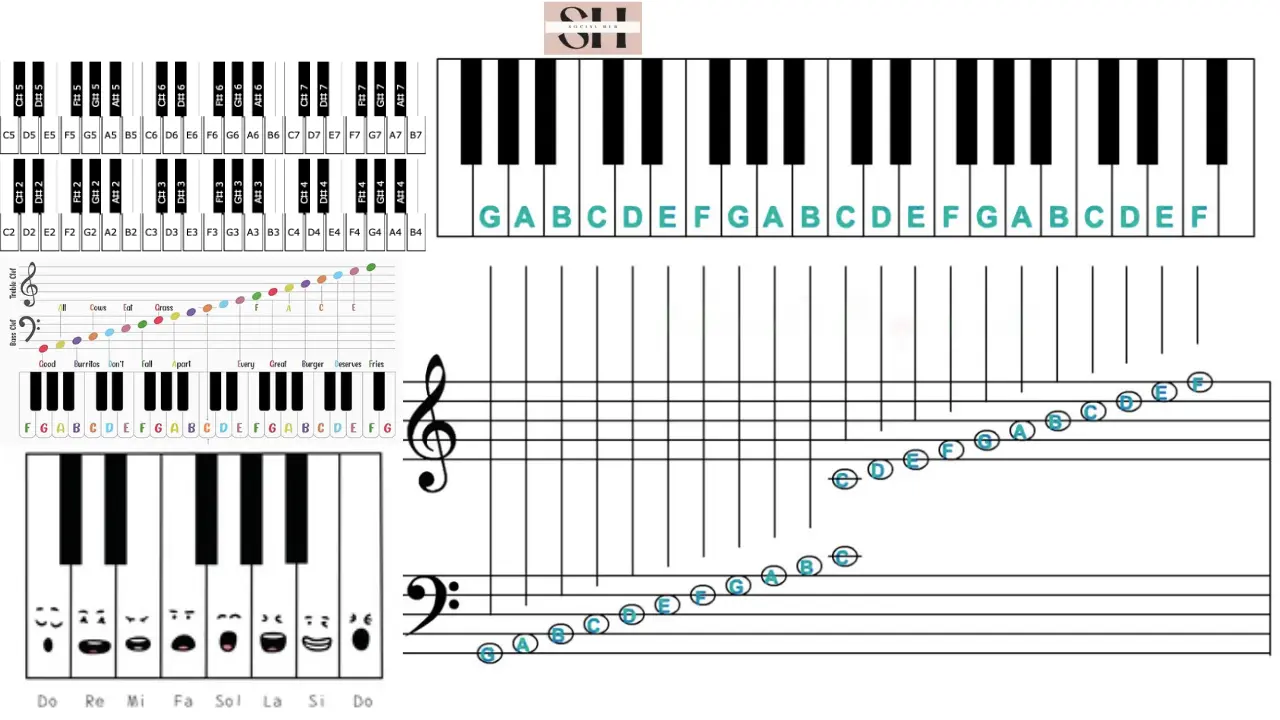
| Key Color | Note Name | Position Tip | Sound Type |
|---|---|---|---|
| White | C | Left of two black keys | Natural |
| Black | C# / Db | Between C and D | Sharp/Flat |
| White | D | Between two black keys | Natural |
| Black | D# / Eb | Between D and E | Sharp/Flat |
| White | E | Right of two black keys | Natural |
| White | F | Left of three black keys | Natural |
| Black | F# / Gb | Between F and G | Sharp/Flat |
| White | G | Between black keys in group of three | Natural |
| Black | G# / Ab | Between G and A | Sharp/Flat |
| White | A | Between black keys in group of three | Natural |
| Black | A# / Bb | Between A and B | Sharp/Flat |
| White | B | Right of three black keys | Natural |
Musical Alphabet
The piano uses only seven letters in its musical alphabet. These letters are A, B, C, D, E, F, and G. After G, the pattern starts again from A. This repeating cycle forms the base of all piano notes labeled charts.
When you look at the keyboard, you see white and black keys. The white keys follow the alphabet in order. Therefore, once you find one note, you can count forward or backward easily. This simple pattern makes reading their notes labeled much easier.
Finding Middle C with Confidence
Middle C sits near the center of most keyboards. Teachers use it as a starting point for reading sheet music. When you learn where it sits, you gain a strong reference point. Many piano notes labeled diagrams highlight Middle C for this reason.
You can find Middle C by looking at groups of two black keys. The white key just to the left of those two black keys is C. The C closest to the middle of the keyboard is Middle C. This clear method makes their notes labeled easy to understand.
White Keys and Natural Notes
White keys represent natural notes without sharps or flats. These keys follow the simple letter pattern from A to G. Because they look clean and wide, beginners often start with them. Most piano note guides show white keys first.
You can play many simple songs using only white keys. This approach helps you focus on timing and hand shape. As you improve, you slowly add black keys to your practice. This step-by-step method keeps learning smooth and fun.
Black Keys Sharps and Flats
Black keys represent sharps and flats in music. A sharp raises a note by one half step. A flat lowers a note by one half step. When you study piano notes labeled, you see that each black key has two names.
For example, the black key between C and D is C sharp and D flat. Both names refer to the same key on the piano. Understanding this idea improves your music reading skills. As a result, their notes labeled charts become even more useful.
Octaves
An octave is the distance from one note to the next note with the same name. For example, C to the next C higher forms one octave. The sound feels similar but higher in pitch. Many piano notes labeled charts divide the keyboard into octaves.
Each octave repeats the same note pattern. This repeating structure makes the keyboard easier to understand. When you learn one octave well, you understand them all. Therefore, studying their notes labeled by octave speeds up learning.
Improve Sheet Music Reading
When you read sheet music, you match symbols to keys. If you know your notes well, your brain responds quickly. You stop hesitating and start playing smoothly. Therefore, piano notes labeled training supports better reading skills.
You also improve hand coordination through repetition. Your fingers learn where to move without constant thinking. Over time, your eyes and hands work together naturally. This progress happens faster when you practice with their notes labeled charts.
Tips for Practicing
You can print a keyboard diagram and place it near your piano. You may also use removable stickers for short practice sessions. However, remove stickers after you learn the notes well. This method keeps piano notes labeled as a learning tool, not a crutch.
Practice finding random notes each day for five minutes. Ask yourself to locate F, then B, then D sharp quickly. This small habit builds strong memory. Soon, you will not need their notes labeled guides anymore.
Building Long-Term Confidence
Learning note names forms the base of all piano skills. Without this base, advanced songs feel confusing and hard. However, once you master the keyboard layout, music feels logical. That confidence begins with piano notes labeled practice.
As you continue learning, you will notice faster progress. Your sight reading improves, and your timing becomes steady. Most importantly, you enjoy playing more because you understand what you play. Clear knowledge of their notes labeled transforms beginners into confident musicians.
Frequently Asked Questions
What do piano notes labeled mean?
It means each key on the keyboard shows its correct note name. This helps beginners learn faster and avoid confusion while practicing.
Why should beginners use their notes labeled charts?
Beginners use their notes labeled charts to understand key positions clearly. These charts improve memory and build strong music-reading skills.
Where is Middle C on a labeled keyboard?
Middle C sits near the center of the piano. It is the white key to the left of a group of two black keys.
Should I keep stickers on my keys forever?
You should use stickers only for early learning. Remove them once you remember the notes confidently.
Conclusion
In conclusion, understanding the keyboard layout creates strong musical foundations. When you study patterns, octaves, and note names, you remove confusion. Clear visuals and repetition help your brain remember faster. With steady practice and focus, mastering piano notes labeled becomes simple and rewarding.