
Secondary 3 introduces students to the Principles of Accounts. This subject builds financial literacy. It teaches the core language of business money.
Students must master basic transaction recording rules. This step is required before tackling difficult financial reporting.
We provide a breakdown of your required sec 3 poa notes below. You can follow along with the educational syllabus structure here. Download the full reference guide to support your studies today.
Business Frameworks and Stakeholders
Distinct Business Operations
The primary purpose of a business is to make profit. Businesses achieve this goal by providing goods or services.
A trading business buys physical goods to resell them. Popular bookstores and local supermarkets operate as classic trading businesses.
A service business provides intangible services instead of physical goods. A teacher showing students how to count 32nd notes operates a standard service business.
Another example is a creator selling digital items like hallelujah lyrics and piano notes online.
Ownership Models Explained
Owners decide how to organize a newly formed business. The syllabus covers sole proprietorships and limited liability partnerships. It also covers private limited companies.
A sole proprietorship is owned completely by one person. This specific owner contributes all the required capital.
The owner maintains absolute control over daily operations. A major disadvantage is the concept of unlimited personal liability. The owner must use personal funds to pay business debts.
Who Uses Accounting Data
A stakeholder uses business information to make decisions. Owners use accounting information to review their ongoing investments.
Managers review the data to find performance improvements. Employees check financial stability to ensure their job security.
Lenders review records to determine bank loan approvals. The government checks financial reports for correct tax collection.
Tracking Financial Elements
Asset and Liability Categories
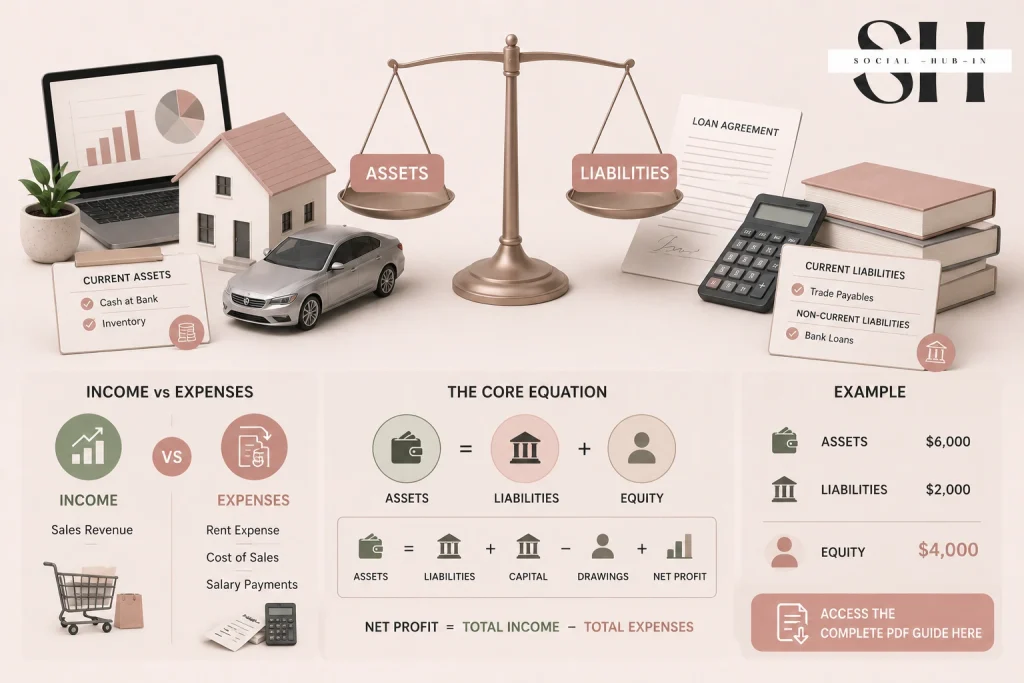
Assets are resources owned or controlled by the business. They are expected to provide future benefits.
Non-current assets provide benefits lasting more than one year. Motor vehicles and office equipment belong in this category. Current assets provide benefits lasting exactly one year or less.
Cash at bank and inventory are current assets. Retailers stock physical goods as inventory for their customers. This might include expensive items like atelier cologne gaiac eternel notes.
Liabilities are financial obligations owed to others. Current liabilities must be repaid within one year. Trade payables are standard current liabilities. Bank loans and long-term mortgages are non-current liabilities.
Income Versus Expenses
Equity represents the owner’s direct claim on net assets. Capital includes resources contributed for daily business use. Drawings happen when assets are taken for personal use.
Income includes all amounts earned through business activities. Sales revenue is earned directly from the main activity of selling.
Expenses are operating costs incurred to earn income. Rent expense, cost of sales, and salary payments are standard expenses.
Applying the Core Equation
The basic rule states that assets equal liabilities plus equity. We can expand this basic mathematical rule for deeper analysis.
Assets equal liabilities plus capital minus drawings plus net profit. Profit is total income minus total expenses.
Students calculate missing account values using this rule. If assets are $6000 and liabilities are $2000, equity is $4000.
ACCESS THE COMPLETE PDF GUIDE HERE
The Mechanics of Double Entry
Rules of Debits and Credits
Every transaction must have at least one debit and credit. The total debit value must perfectly equal the total credit value.
Assets, expenses, and drawings are positive on the debit side. They become negative on the credit side.
Liabilities, income, and capital are positive on the credit side. They become negative on the debit side.
Breaking Down Transactions
Business transactions need recording in the accounting system. A transaction is recorded when it affects the business directly.
It must have a measurable monetary value. Personal spending by the owner does not affect business records.
You must identify specific accounts affected by the transaction. Then you apply the debit and credit rules to those changes.
Logging Transaction Effects
Buying inventory using a cheque increases your inventory current asset. It simultaneously decreases your cash at bank asset equally.
Taking a bank loan increases your cash at bank asset balance. It equally increases your bank loan non-current liability.
Paying rent with a cheque decreases your cash at bank asset. It equally increases your rent expense for that period.
Generating Financial Reports
Drafting the Trial Balance
A trial balance lists all ledger accounts and ending balances. It separates balances strictly according to debits and credits.
This format checks for arithmetic errors in mathematical calculations. It helps accountants safely prepare the final formal financial statements.
Total debits at the bottom must exactly equal total credits. Workings for adjustments are displayed in brackets beside the account.
Evaluating Business Performance
This statement presents the balances of business income and expenses. The specific format depends on the exact business type.
Trading businesses must include a specific trading portion. This section calculates gross profit by deducting the cost of sales.
The profit and loss portion reports the overall net profit. Service businesses do not have a trading portion in their statements.
Assessing Financial Position
This statement reports assets, liabilities, and equity at a date. Total assets must always mathematically equal total equity and liabilities.
Non-current assets are listed first in the asset section. Current assets like inventory and trade receivables are listed below that.
Equity shows the beginning capital plus net profit minus drawings. Current liabilities show short-term debts like trade payables.
Frequently Asked Questions
What is the primary focus of accounting?
Accounting is an information system designed to provide financial data. Stakeholders rely on this data to make informed business decisions. It tracks income, controls spending, and ensures legal tax compliance.
How do debits and credits function?
Every business transaction requires dual recording to maintain balance. You must log at least one debit and one credit entry. The total financial value of all debits must equal all credits.
What role do source documents play?
A source document is physical or digital evidence of a transaction. It proves that a financial exchange actually occurred. Examples include supplier invoices, cash receipts, and official bank statements.
What is the value of a trial balance?
Accountants draft a trial balance to verify basic mathematical accuracy. It confirms that the double entry recording rules were applied consistently. This step is mandatory before generating official financial statements.
How is gross profit determined?
Gross profit isolates the earnings generated strictly from trading physical goods. You calculate it by finding your final net sales revenue. Then, you subtract the total cost of sales from that figure.
DOWNLOAD YOUR EXAM REVISION PDF
Final Takeaways
Mastering your accounting foundation requires consistent practice and logical problem solving. Memorizing ledgers without understanding the basic rules causes examination failures.
Start by applying the expanded accounting equation to your transactions. Always remember that total debits must safely equal your total credits.
Learn how to interpret source documents before attempting formal journal entries. Apply this framework actively to secure top marks in assessments.