
Learning notes on a guitar helps every beginner understand music better and play songs with confidence and skill. When you know where each note sits on the fretboard, you can build chords, scales, and melodies with ease. This guide explains the basics clearly so that even new players can understand and practice effectively. As a result, you will gain strong knowledge that improves both playing and musical creativity.
Basic Notes on a Guitar
Music uses seven natural notes, and every instrument follows this same musical pattern in theory and practice. These notes include A, B, C, D, E, F, and G, and they repeat again and again across the fretboard. When beginners study these carefully, they start recognizing notes on a guitar quickly while practicing songs. Therefore, knowing these musical notes creates a solid base for learning scales and chords.
| Natural Notes | Description |
|---|---|
| A | One of the main musical notes used in scales |
| B | Appears before C in the musical pattern |
| C | Often used as the starting note in music theory |
| D | Common in many guitar chords |
| E | Important open string note on guitar |
| F | Appears right after E |
| G | Frequently used in chords and melodies |
Open Strings
A standard guitar contains six strings, and each string has a specific note when played open. These open notes create the starting point for understanding these notes across the entire fretboard. When beginners memorize these open strings first, learning other notes becomes much easier and faster. Consequently, open string notes form the first step in mastering guitar music.
| String Number | String Name | Open Note |
|---|---|---|
| 6th | Thickest string | E |
| 5th | Second thickest | A |
| 4th | Middle string | D |
| 3rd | Third thin | G |
| 2nd | Second thin | B |
| 1st | Thinnest string | E |
Fretboard Changes Each Note
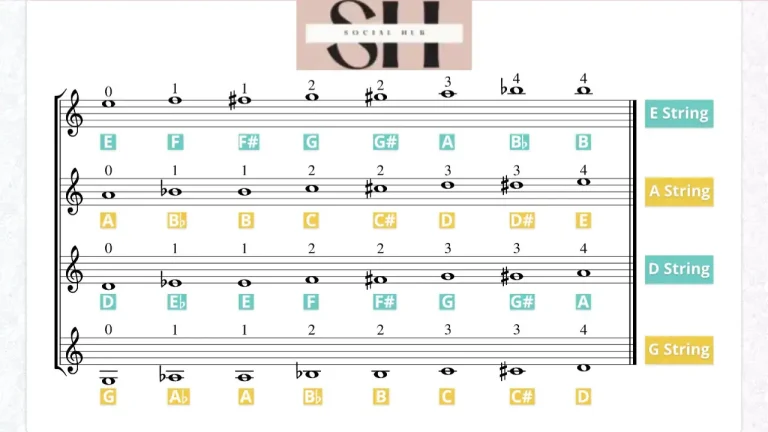
Every fret on the guitar changes the pitch of the note by a half step as you move up the neck. When a player presses the first fret, the note becomes slightly higher than the open string sound. Because of this pattern, the notes on a guitar follow the same repeating musical sequence across every string. Therefore, learning this pattern helps guitar players locate notes quickly without confusion.
Twelfth Fret
The twelfth fret marks a very special position on every guitar neck and repeats the original open note. For example, the open sixth string produces E, and the twelfth fret produces the same note one octave higher. Understanding this simple rule helps beginners locate these notes faster while practicing scales. In addition, the twelfth fret helps players understand how octaves work in music.
Sharps and Flats
Music also includes sharp (#) and flat (b) notes between most natural notes on the musical scale. A sharp note means the pitch rises slightly, while a flat note lowers the pitch slightly instead. These small changes help create more musical tones and appear frequently in notes on a guitar. Because of this, learning sharps and flats expands your ability to play different songs and styles.
| Natural Note | Sharp | Flat |
|---|---|---|
| A | A# | Bb |
| C | C# | Db |
| D | D# | Eb |
| F | F# | Gb |
| G | G# | Ab |
Guitar Players Should Memorize Notes
Memorizing the location of each note helps guitar players move smoothly across the fretboard. When you understand notes on a guitar, you can build chords faster and play melodies without guessing. This knowledge also improves improvisation because you know exactly which notes belong in a scale. As a result, memorizing notes makes you a more confident and skilled musician.
Easy Tips for Learning
Many beginners struggle to remember fretboard notes at first, but simple practice methods help a lot. For example, learning one string at a time allows players to focus on fewer notes and remember them easily. When you practice this daily, identifying these notes becomes faster and more natural. Over time, your brain starts recognizing patterns instead of memorizing each note separately.
Build Chords and Scales
Every chord and scale comes from combining different musical notes in a specific order. When you already understand notes on a guitar, building chords like C major, G major, or D major becomes simple. Scales also become easier because they follow clear note patterns across the fretboard. Therefore, learning notes strengthens every other part of guitar playing.
Frequently Asked Questions
Why is it important to learn notes on a guitar?
Learning these notes helps players understand the fretboard and improves their ability to play chords and melodies.
How many notes are on a guitar fretboard?
The guitar uses the 12-note musical system, and these notes repeat across the entire fretboard on every string.
What are the open strings on a guitar?
The six open strings are E, A, D, G, B, and E, starting from the thickest string to the thinnest string.
What is the easiest way to memorize guitar notes?
The easiest method is learning one string at a time and practicing note patterns regularly on the fretboard.
Final Thoughts
Understanding notes on a guitar gives beginners a strong musical foundation that improves both practice and performance. When you learn the fretboard step by step, the guitar stops feeling confusing and starts feeling logical. With regular practice, players quickly recognize notes and use them to create music confidently. Eventually, this knowledge helps every guitarist grow from a beginner into a skilled musician.