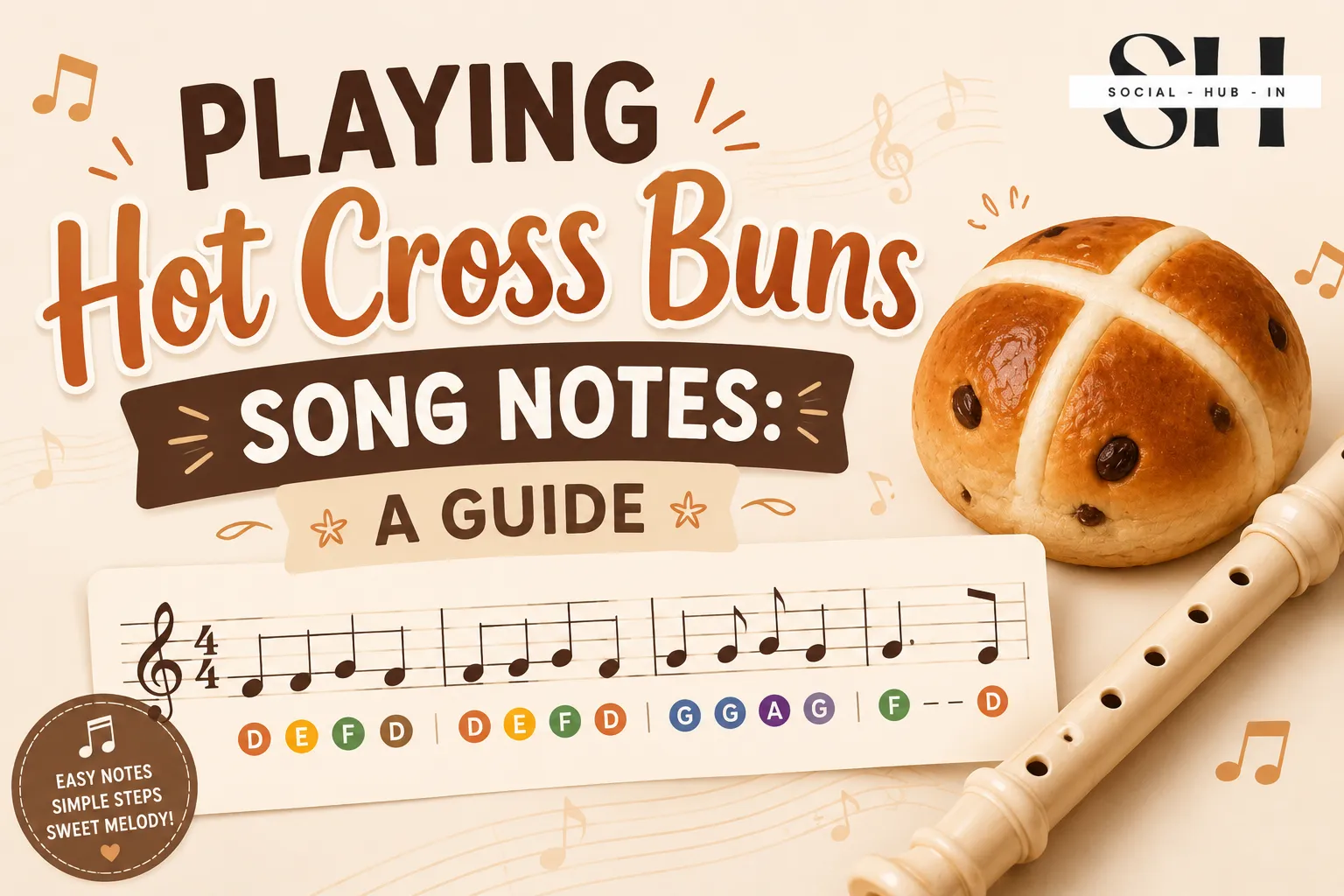
“Hot Cross Buns” is usually the very first song a music student learns. It features a very simple and repetitive three-pitch melody. Teachers use it globally to introduce basic musical concepts to children.
This guide breaks down the exact pitches and rhythmic values you need. You will learn how to play this famous nursery rhyme on multiple instruments. We provide the sheet music translations for piano, recorder, and guitar below.
The Basic Melodic Structure
Understanding The Three Pitches
The entire song uses only three consecutive notes going downward. Musicians describe this descending scale pattern as mi, re, and do. These represent the third, second, and first degrees of a major scale.
Because the melody is so small, beginners memorize it very quickly. You do not need to move your hands to different positions. Your fingers simply drop down the keys or holes in order.
The Repeating Musical Form
The overall melodic structure follows a standard A-A-B-A pattern. This means the first, second, and fourth lines are exactly identical. You only need to learn two distinct musical phrases to play the whole piece.
The third line provides a slight rhythmic variation. This breaks up the repetition and keeps the listener engaged.
Reading The Rhythm And Time Signature
Quarter And Half Durations
Composers typically write the song in a standard four four time signature. Some teachers prefer to write it in two four time instead. The rhythmic values remain proportional either way.
The song introduces beginners to three basic note durations immediately. The words “hot” and “cross” are played as quarter notes. The word “buns” is held twice as long as a half note.
Playing The Eighth Notes
The third line of the song introduces a faster rhythm entirely. The lyrics “one a penny, two a penny” use eighth notes. You play two sounds for every single beat of the metronome.
This forces the student to speed up their tongue or fingers. The song then returns to the slower quarter notes for the final line. This contrast teaches basic timing control very effectively.
Playing On Different Instruments
Hot Cross Buns Piano Letters
Piano teachers usually teach this song in the key of C major. The student places their right hand over the middle keys. The melody uses the pitches E, D, and C.
The exact pattern is E, D, C for the first line. You repeat E, D, C for the second line. The third line is C, C, C, C followed by D, D, D, D. The final line returns to E, D, C.
Recorder And Wind Instruments
Recorder players learn a slightly different version for physical reasons. Covering the top holes is easier for young hands. Therefore, teachers use the key of G major instead.
The melody for the recorder uses the pitches B, A, and G. The rhythmic pattern remains exactly the same as the piano version. You just blow air through different fingering positions.
String Instrument Adaptations
Violin students also start their musical journey with this specific melody. They typically pluck the strings before they learn to use the bow. Teachers often start them on the A string or D string.
Advanced beginners might move the melody higher up the instrument. A student learning the notes on e string violin can play a very bright version of the song. The finger spacing remains the same across the different strings.
Bass And Lower Registers
You can even play this nursery rhyme on heavy rhythm instruments. A student mapping out the notes on the bass guitar neck plays the exact same intervals. They usually play it in D major using F sharp, E, and D.
The thick strings give the light melody a very heavy, dark sound. It proves that music theory applies equally to every single instrument.
Other Common Variations
Harmonica players can easily learn this song on their first day. The diatonic layout makes playing three descending pitches very simple. A student learning the notes on a harmonica c just moves their mouth one hole over.
They blow into hole five, draw on hole four, and blow into hole four. This produces the exact same E, D, and C melody as the piano.
Historical Origins And Lyrics

The English Street Vendor Cry
This famous song originated as a short English street cry. Street vendors sang these short, catchy melodies to sell their daily goods. The song advertised sweet, spiced buns marked with a cross on top.
Bakers traditionally sold these specific buns at the end of Lent. People bought them to eat on Good Friday. The catchy sales pitch eventually became a permanent children’s song.
The Full Standard Lyrics
The modern lyrics are very short and easy to memorize. The entire song consists of just four lines of text.
- Hot cross buns!
- Hot cross buns!
- One a penny, two a penny,
- Hot cross buns!
Frequently Asked Questions
What Are The Three Notes For Hot Cross Buns?
The pitches depend on your specific instrument. Piano players use E, D, and C. Recorder players use B, A, and G.
Why Is This Always The First Song Taught?
It uses only three consecutive pitches going downward. The rhythm is highly repetitive and easy to count. This limits the physical frustration for new musicians.
What Time Signature Does The Song Use?
Sheet music publishers usually write it in common four four time. You will sometimes see it written in two four time for younger students.
Do I Need To Use Both Hands On The Piano?
No, you only need to use your right hand. You place your third finger on E, your second finger on D, and your thumb on C.
Can I Play It On A Trumpet?
Yes, trumpet players can easily learn this melody. They use the exact same rhythmic values but apply their specific valve fingerings instead.
Final Takeaways
Mastering this short nursery rhyme gives beginners instant musical confidence. The simple three-pitch melody requires very little physical movement. You can focus entirely on your timing and rhythm instead of finding keys.
Always practice the fast eighth notes slowly with a metronome at first. The transition from half notes to fast notes often trips up new players. Understanding this basic structure prepares you for much harder songs later on.