Learning a new song requires patience and the right resources. Finding accurate hallelujah lyrics and piano notes gives you a strong starting point. This track remains a popular choice for both beginners and experienced musicians. The slow tempo and basic chords make it highly accessible. We provide a complete breakdown of the sheet music and vocal lines below. You can use this guide to practice your timing and chord transitions effectively.
Historical Context and Song Details
Original Release and Songwriter
Leonard Cohen originally wrote and recorded this track. He released the song in 1984. It blends pop, folk-rock, and traditional singer-songwriter styles. The song did not achieve massive commercial success immediately upon release. It took several years and different renditions to gain global recognition. Today, it stands as one of the most recognizable melodies in modern music.
Popular Cover Versions
Many artists have recorded successful covers of this track over the decades. Jeff Buckley released one of the most famous and acclaimed versions. Rufus Wainwright also recorded a widely recognized cover for a movie soundtrack. Pop groups like Pentatonix and singers like Alexandra Burke have produced chart-topping renditions. These covers helped the song reach a wider audience across different generations.
Musical Structure and Basic Mechanics
The Key of C Major
The sheet music places the song perfectly in the key of C Major. This key is ideal for beginner piano players. It primarily uses the white keys on the standard keyboard. This limits the need to memorize complex sharp or flat notes. It allows new players to focus purely on their timing and hand placement.
Time Signature and Tempo
The song uses a standard 6/8 time signature. You count this beat in two groups of three. You count it verbally as one-two-three, four-five-six. The tempo is usually very slow, sitting around 56 beats per minute. This slow pace gives you plenty of time to transition between chords. It also matches the solemn and emotional tone of the lyrics.
Breaking Down the Piano Chords
Primary Chord Progressions
The basic chord structure relies heavily on simple major and minor triads.
- The C Major chord requires the notes C, E, and G.
- The A minor chord uses the notes A, C, and E.
- The F Major chord consists of F, A, and C.
- The G Major chord includes G, B, and D.
- The E minor sequence uses the notes E, G, B, and A.
Intro and Verse Patterns
The introduction establishes the basic rhythm immediately. You play a pattern alternating between chords. The specific intro notes start with C, G, C, followed by E, C, G. The verse begins with the lyrics mentioning a secret chord. It states that David played it and it pleased the Lord. The lyrics describe the actual musical shifts happening in the progression.
Playing the Chorus
The chorus provides an emotional release in the music. The vocal melody repeats the word “Hallelujah” multiple times. The notes for the chorus melody include sequences like E-G, A-A, and A-G. The section resolves cleanly at the end. This resolution creates a satisfying musical conclusion before the next verse begins.
Complete Lyrical Composition
Verses One and Two
The first verse introduces the central musical theme. The singer states: “I heard there was a secret chord”. He mentions that David played it to please the Lord. The singer then explains the progression: “the fourth, the fifth”. He notes the “minor falls” and “major lifts”. The verse ends by mentioning a baffled king composing Hallelujah.
The second verse explores a story of intense temptation. It opens by stating the subject’s faith was strong. However, they needed physical proof. The lyrics describe seeing a woman bathing on a roof. The narrative then shifts to a scene in a kitchen. She tied the subject to a kitchen chair. She broke his throne and cut his hair. From his lips, she drew the Hallelujah.
Verses Three and Four
The third section takes a more reflective and personal approach. The singer admits to having been in this room before. He states he used to live alone before meeting this person. He mentions seeing her flag on the marble arch. The most famous line defines his view of romance. He states that love is not a victory march. Instead, it is a cold and broken Hallelujah.
The fourth verse compares physical closeness to religious experiences. The singer remembers a time when communication was completely open. He knew exactly what was going on below the surface. He recalls a past moment of deep connection. He states that the holy dove was moving with them. Every single breath they drew was a Hallelujah.
The Final Verse
The fifth verse questions the nature of divine guidance. The singer admits there might be a God above. However, his personal experience with love has been violent. He claims love only taught him how to shoot. He learned to shoot at someone who outdrew him in a duel. He explains that this song is not a cry heard at night. It remains a cold and broken expression.
Learn More: Atelier Cologne Gaïac Éternel Notes
Reading the Sheet Music
Understanding the Treble Clef
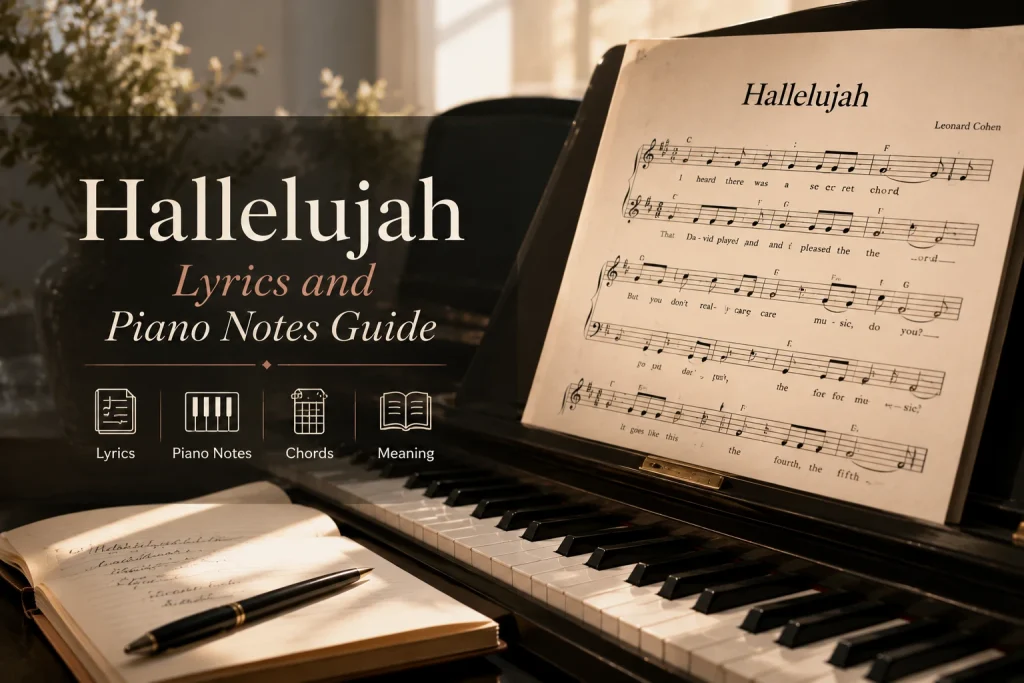
Beginners must learn to read the treble clef first. The treble clef dictates the notes played by the right hand. The melody line is written directly on this specific staff. You read the notes from left to right. The spaces spell out F-A-C-E from bottom to top. The lines represent E-G-B-D-F. Memorizing these positions speeds up your learning process.
Reading the Bass Clef
The bass clef guides your left hand on the piano. It provides the low supporting notes for the chords. The spaces on this staff represent A-C-E-G. The lines represent G-B-D-F-A. Playing the bass notes accurately is essential for a full sound. It gives the C Major and A minor chords their heavy, emotional weight.
Following the Measure Lines
Sheet music uses vertical lines to create measures. Because the time signature is 6/8, each measure holds six eighth notes. You must stay within this counting structure. Do not rush the exact tempo. Keep your foot tapping to maintain a steady, slow rhythm. This ensures your playing matches the original recording accurately.
Frequently Asked Questions
What is the original key for the piano sheet music?
The original key for the sheet music is C Major. This makes it highly accessible for beginners. It limits the use of black keys, allowing for easier hand placement.
How do you count the time signature?
The sheet music uses a 6/8 beat. You should count this in two groups of three. Count one-two-three, four-five-six at a slow, steady tempo.
What are the exact notes for the F Major chord?
The F Major chord is a simple triad. It consists of the notes F, A, and C. You play these three notes simultaneously to form the chord.
Why is this song considered good for beginners?
The slow tempo of 56 BPM allows for easy chord transitions. The progression uses basic major and minor chords. There are very few complicated finger stretches required to play it.
Final Takeaways
Mastering this track requires a basic understanding of major and minor triads. The C Major key simplifies the learning process for new players. Pay close attention to the 6/8 time signature to maintain the correct rhythm. Practice the transition between the C Major and A minor chords thoroughly. The lyrics themselves will guide you through the major musical shifts. Consistent practice will help you build muscle memory for the difficult chorus sections.