Losing a loved one turns your daily routine upside down. Friends and family step in to offer immediate support. They send food, flowers, and donations to honor the deceased. The weeks following a service feel like a blur. Eventually, you must acknowledge their kindness and generosity.
Writing thank you notes after funeral to friends requires mental energy. You want to acknowledge their support properly during your mourning period. This guide explains how to manage this task without adding stress. We cover proper timing, who to prioritize, and exactly what to write. You will find practical examples below to copy directly.
Understanding Proper Etiquette And Timing
When To Send Your Messages
Standard etiquette suggests sending messages within two to four weeks. The funeral service marks the beginning of a long grieving process. Friends understand if you need more time to process your emotions.
Late notes are always acceptable in these situations. You should never feel rushed to complete this administrative task. Your mental health takes priority over mailing deadlines. A delayed card carries the exact same gratitude as an early one.
Choosing The Right Stationery
The funeral director often provides small acknowledgment cards. You can use these for your official messages. You can also purchase your own blank stationery from a store.
Small cards work best because they limit the writing space. You only need room for two or three short sentences. Writing long letters is not required. Heavy cardstock with quiet nature scenes feels appropriate. Avoid brightly colored stationery or humorous greeting cards.
Prioritizing Your Recipient List
You do not need to send a card to every attendee. Focus your energy strictly on people who offered specific support. Send cards to friends who sent floral arrangements to the church. You should acknowledge anyone who made a formal memorial donation.
Pallbearers and musicians require a specific written acknowledgement for their services. Clergy members and the person who delivered the eulogy should receive a note. Friends who traveled long distances to attend also deserve a card. General guests do not require a formal written response.
Tracking Gifts And Organizing Data
Organizing The Information Early
You need a reliable system to track incoming support during the week. A simple spiral notebook works perfectly for this job. Keep it in a central location near your front door.
Write down every delivery as soon as it arrives at the house. Do not rely on your memory during this stressful time. Keep the small florist cards taped inside the notebook pages. This prevents you from losing important sender information.
Assigning A Record Keeper
Assign this tracking job to a trusted friend or extended family member. They can write down exactly who sent each floral arrangement. They can also log the daily food deliveries from neighbours.
This takes the administrative burden off your shoulders completely. You will rely heavily on this master list when writing your cards. A good record keeper ensures nobody is forgotten during the process.
Structuring Your Written Message
Opening With A Warm Salutation
Always address your friend directly by their first name. This keeps the tone personal, warm, and authentic. Avoid overly formal greetings for close friends.
Use simple openers like Dear John or Dearest Sarah. If writing to a married couple, include both of their names. Addressing the card correctly sets a respectful tone immediately.
Acknowledging Specific Acts Of Kindness
Name the exact gift or act of service provided by the person. Mention the specific type of food they delivered to your home. Name the specific charity they chose for their financial donation.
If they sent a floral arrangement, reference it clearly. People sometimes read funeral notes for flowers to write their attached messages. Reference those specific words or the specific flowers they picked. Specific details show that you noticed their individual effort.
Closing And Signing Off
End your message with a warm and standard closing statement. Good options include With love, Warmly, or Sincerely. Sign your name clearly at the bottom of the card.
If you are writing on behalf of the whole family, state that clearly. You can sign it The Smith Family to represent everyone. Clear handwriting ensures your friend knows exactly who sent the acknowledgement.
Example Messages For Different Situations
Acknowledging Floral Arrangements
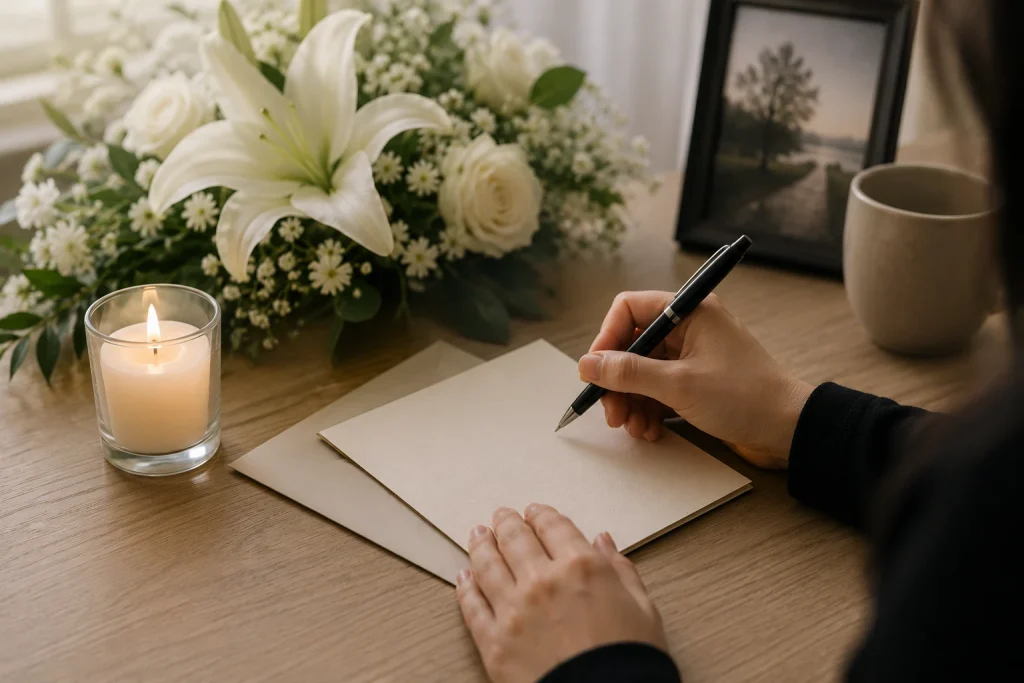
Flowers provide visual comfort during the service and at the graveside. Acknowledge the specific beauty of the arrangement they chose.
- Thank you so much for the beautiful white roses.
- The lilies brought our family great comfort this week.
- We appreciate the gorgeous floral wreath you sent.
- Your beautiful flowers brightened a very dark day.
- The peaceful lilies added grace to the church altar.
- We appreciate the stunning basket of spring flowers.
Recognizing Charitable Donations
Friends often donate money to honor the deceased person’s legacy. Name the specific charity in your written response.
- Thank you for your generous donation to the animal shelter.
- My father loved dogs, and your gift means everything.
- We appreciate your support of the cancer research fund.
- Your donation honors my mother in a beautiful way.
- We are touched by your generous memorial contribution.
- Your gift to the children’s hospital is appreciated.
Appreciating Food And Daily Help
Friends often provide tangible help like delivering meals or running errands. This practical support keeps the grieving family functioning. Sometimes, friends help organize music for the post-service reception.
They might help a young relative practice hot cross buns song notes for a tribute. They might coordinate a band playing notes on 4 string bass for a memorial. Acknowledge this specific physical labor.
- Thank you for organizing the meals for our family.
- Your lasagna took a massive weight off our shoulders.
- We appreciate you hosting our relatives from out of town.
- Thank you for driving the kids to school all week.
- Thank you for mowing our lawn last weekend.
- Your grocery delivery saved us so much time.
Digital Alternatives And Modern Etiquette
Sending Digital Messages
Traditional etiquette demands physical paper cards for funerals. Modern practices are slowly changing to accommodate digital communication. Sending an email is acceptable for distant professional colleagues or clients.
However, physical cards remain the standard requirement for close friends. Paper carries a physical weight that matches the gravity of the event. An email often feels too casual for such a serious occasion. Stick to paper whenever possible.
Using Social Media For General Thanks
You might receive hundreds of condolence messages online. Replying to every social media comment is impossible. You can post one general message of thanks on your profile page.
This covers the wider circle of acquaintances and former coworkers. You still need to mail physical cards to people who sent gifts. Social media does not replace the need for formal written acknowledgements.
Managing The Emotional Workload
Asking Family Members For Help
You do not have to write every single card yourself. Divide the recipient list among your immediate family members. One person can write to the professional colleagues and business partners.
Another person can write to the extended family members. Sharing the workload prevents emotional burnout. It also speeds up the mailing process significantly.
Setting Realistic Expectations
Do not try to write fifty cards in one day. Set a goal of writing five cards each morning. This limits your emotional exposure to a manageable level.
Stop writing immediately if you feel overwhelmed or sad. The cards can easily wait until tomorrow. Pushing through exhaustion will only make the task harder.
Handling Difficult Emotional Responses
Writing these cards forces you to remember the funeral details. Crying is a normal physical response to this administrative task. Keep tissues nearby while you work at your desk.
Take frequent breaks to walk outside and breathe fresh air. You might stare at a blank card for ten minutes. Grief slows down normal brain functions naturally. Copy the examples provided here to save mental energy.
Frequently Asked Questions
Do I need to send a card to everyone who attended?
No, you only need to acknowledge specific gifts or acts of service. General attendees do not require a formal written response.
How late is too late to send a card?
It is never too late to send an acknowledgment. Even if months have passed, your friends will appreciate the thoughtful gesture.
Should I handwrite every single message?
Handwritten messages are the traditional standard for funerals. However, you can use printed cards if handwriting causes you physical pain. Just sign your name at the bottom.
What if I forget what a specific friend sent?
Keep a notebook next to the front door to log deliveries. Write down every gift or meal as it arrives. This prevents any confusion later.
Can I ask someone else to sign the cards for me?
You can ask a family member to write the body of the message. You should try to sign your own name at the bottom if possible.
Final Takeaways
Writing acknowledgment cards is the final formal step of the funeral process. It allows you to close the administrative chapter of your loss. Do not let this task become a source of anxiety.
Your friends sent gifts to support you, not to burden you with paperwork. They will appreciate your message regardless of when it finally arrives in their mailbox. Rely on the short examples provided above to save your mental energy. Ask your family members to help address the envelopes. Take your time and process your grief at your own pace.