The viola serves as the tenor voice of the string family. It sits squarely between the violin and the cello. It has a distinctively warm and dark tone.
Learning the notes of the viola requires understanding its specific tuning. You must also learn how to read its unique sheet music.
This guide breaks down the open strings and standard pitch ranges. We explain how to tune the instrument accurately.
You will learn about the alto clef and basic playing techniques. This knowledge builds a strong foundation for new players.
Viola Strings and Standard Pitch
The Four Open Strings
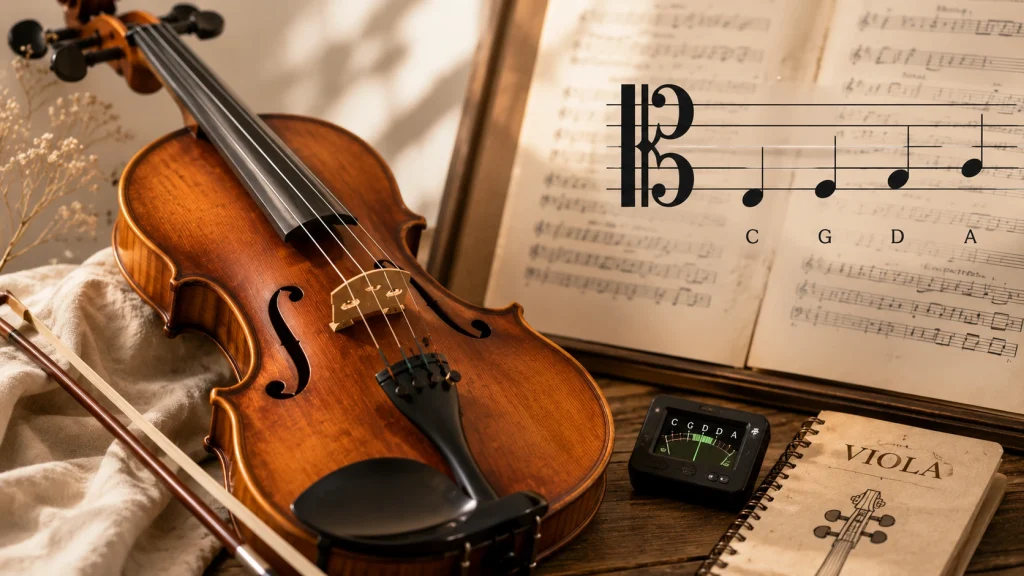
The instrument features exactly four strings. These strings are tuned in perfect fifths. The lowest open string is the C string.
This string is known technically as C3. It sits an octave below middle C on a piano. The next string up is the G string.
The G string is tuned to G3. It is a perfect fifth above the C string. The third string is the D string or D4.
The highest open string is the A string or A4. This top string provides the standard tuning reference point.
Tuning Mechanics and Process
Players usually tune the A string first. They use a standard A-440 tuning fork. They can also use a digital tuner.
In an orchestra setting, the oboe provides this reference pitch. Once the A string is accurate, the player tunes the D string.
They listen for the interval of a perfect fifth. Players often use double stops to check their tuning.
A double stop involves bowing two strings at the exact same time. This ensures the frequencies match perfectly.
Instrument Comparisons
The viola differs greatly from other stringed instruments. It is tuned exactly a perfect fifth lower than the violin.
The violin uses G, D, A, and E strings. The viola is tuned one octave higher than the cello.
The cello shares the exact same C, G, D, and A tuning structure. These physical differences give the instrument its slightly subdued sound.
Reading Viola Sheet Music
Understanding the Alto Clef
This instrument primarily uses the alto clef. It is the only standard orchestral instrument that reads this specific clef regularly.
The alto clef is a type of C clef. Middle C is located directly on the middle line of the five-line staff.
This placement keeps the most common notes within the staff boundaries. It prevents the need for an excessive number of ledger lines.
Ledger lines make sight-reading difficult for beginners. The alto clef simplifies the reading process for the middle register.
Transitioning to the Treble Clef
Players do not only read the alto clef. The sheet music will sometimes switch directly to the treble clef.
This switch happens during passages played in higher registers. It typically occurs for notes extending beyond the G above middle C.
Musicians often transition between different instruments. A player reading hallelujah lyrics and piano notes focuses on treble and bass clefs.
A violist must learn to read both the alto and treble clefs fluently.
Understanding the Pitch Range
The standard playable range is very wide. It extends from C3 to A6. C3 is the lowest open string.
A6 is reached in higher positions on the top string. Advanced players can push this range even higher.
They can reach up to E7 by using artificial harmonics. Mastering this full range takes consistent practice.
Beginners should focus on the first position notes before moving higher.
Physical Mechanics and Techniques
Posture and Positioning
Playing this instrument requires physical strength. It is larger and heavier than a standard violin.
Players must adapt their hand positions and bowing techniques. Proper posture prevents physical strain during long practice sessions.
The instrument should rest securely on the collarbone. The left hand supports the neck without gripping it tightly.
Tension in the left hand causes playing errors. A relaxed posture improves overall sound quality.
Bowing Methods
The thicker strings require more bow weight. Players must apply pressure to produce a clear, warm sound.
Drawing the bow straight across the strings is a mandatory rule. Crooked bowing produces a scratchy or weak tone.
Different bowing speeds change the volume of the notes. Faster bow strokes create a louder sound.
Slower bow strokes produce a quieter, more subdued tone.
Left-Hand Fingering
The left hand presses the strings against the fingerboard. This action changes the pitch of the note.
Accurate finger placement is required for good intonation. String instruments do not have frets to guide the fingers.
Players rely entirely on muscle memory and ear training. Placing a finger slightly off-center changes the pitch entirely.
Consistent practice builds the required muscle memory for accurate fingering.
Maintenance and Tone Production
String Materials
String material heavily impacts the tone. Traditional strings were made from animal gut.
Gut strings offer a very warm and complex sound. However, they go out of tune quickly in changing temperatures.
Steel core strings are much more stable. They produce a brighter and louder tone.
Synthetic core strings offer a middle ground. They provide the warmth of gut strings with the stability of steel.
Rosin Application
Rosin is applied directly to the bow hair. It creates friction between the bow and the strings.
Without rosin, the bow would slide silently across the strings. Applying too much rosin creates a harsh, scratchy sound.
Players must find the correct balance for their specific instrument. Darker rosins are often preferred for thicker strings.
The darker rosin provides more grip for heavier bowing.
Environmental Factors
Wood instruments are sensitive to environmental changes. Extreme heat or cold can damage the wood.
Humidity levels also affect the tuning stability. Dry environments can cause the wood to crack.
Players use humidifiers inside their cases to protect the instrument. Proper storage extends the lifespan of the instrument.
Always wipe rosin dust off the strings after playing.
Advanced Playing Techniques
Mastering Vibrato
Vibrato adds warmth and expression to a sustained note. It involves a slight, rapid fluctuation in pitch.
The player rolls their left finger back and forth on the string. This motion must be controlled and even.
A wider vibrato creates a more dramatic sound. A narrow vibrato is suited for delicate musical passages.
Pizzicato Execution
Pizzicato is the technique of plucking the strings with the fingers. The bow is not used for these specific notes.
The player usually plucks with the index finger of the right hand. The resulting sound is short and percussive.
This technique provides rhythmic support in orchestral pieces. It contrasts sharply with smooth, bowed notes.
Artificial Harmonics
Harmonics produce high, flute-like tones. Natural harmonics occur when lightly touching the string at specific nodes.
Artificial harmonics require pressing the string down with one finger. A second finger lightly touches a higher node on the same string.
This advanced technique extends the upper range of the instrument. It requires extreme precision in left-hand finger placement.
Practical Instrument Application
Orchestral Roles
The dark tone is highly valued in chamber music. It bridges the gap between the high violins and low cellos.
The instrument often plays the inner harmonic lines. It supports the main melody played by the violins.
A good player knows how to project their sound properly. They avoid being overpowered by the rest of the orchestra.
This middle voice adds depth to the overall composition.
Learning Different Systems
Sheet music formats change across different instrument families. A harmonica player reads specific mouth organ music notes to find the right pitch.
String players read standard staff notation. They must translate the notes directly to the fingerboard.
Understanding the relationship between the clef and the strings is an absolute requirement. This skill allows for quick sight-reading during performances.
Musical Selection
Classical repertoire often includes solemn pieces suited for quiet ceremonies. The dark tone fits respectful environments perfectly.
A director might select these pieces much like picking funeral notes for flowers. The music sets the mood for the event.
The instrument also excels in lively folk music. Its versatile range fits many different musical styles.
Musicians can adapt their playing style to suit the genre.
Frequently Asked Questions
What are the four notes of the viola?
The four open strings are C, G, D, and A. The C string is the lowest, and the A string is the highest.
Why does this instrument use the alto clef?
The alto clef places middle C exactly on the center line. This perfectly matches the instrument’s middle pitch range. It reduces the need for confusing ledger lines.
How is it different from a violin?
It is physically larger and heavier than a violin. It is also tuned a perfect fifth lower. This gives it a deeper, warmer sound profile.
What is the standard pitch range?
The standard range goes from C3 to A6. Advanced bowing techniques allow players to reach higher pitches up to E7.
How do players tune the strings?
Players tune the A string to 440 Hz first. They then tune the remaining strings by listening for perfect fifth intervals.
Final Takeaways
Mastering this instrument requires dedication and focused practice. Learning to read the alto clef is your first major hurdle.
Once you understand the clef, you can move across the fingerboard easily. Always start your practice sessions by tuning the open strings accurately.
Listen carefully to your double stops to ensure perfect fifth intervals. Build your physical endurance to handle the larger instrument size.
Consistent practice will help you unlock its rich and warm tone. Your role as the middle voice in an orchestra is highly valuable.