
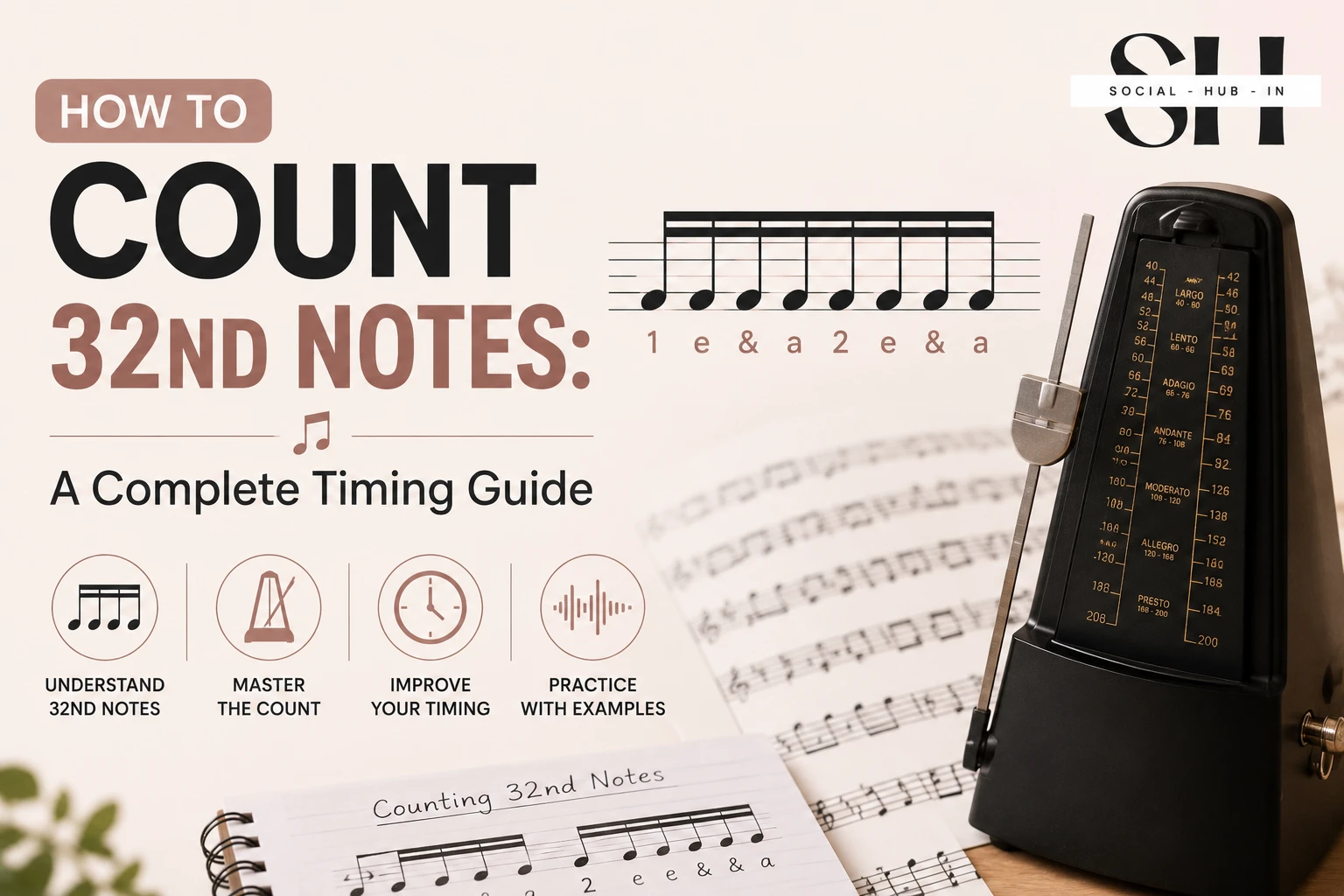
Reading fast rhythms can confuse new musicians. The thirty-second note is one of the fastest standard subdivisions in sheet music. It requires quick counting and steady mental focus.
We provide a breakdown of this specific rhythm below. You will learn the basic math behind the music. We also share vocal exercises to improve your physical timing.
Understanding rhythm and music theory
The basic music math
Music divides time into strict mathematical fractions. A standard song usually uses a four four time signature. This means one measure contains exactly four quarter note beats.
You can divide these quarter notes into smaller equal pieces. One quarter note equals two eighth notes. It also equals four sixteenth notes.
A quarter note breaks down into exactly eight thirty-second notes. This means a full measure contains thirty-two of these fast notes. Tracking this many sounds requires a reliable system. Much like reading sec 3 poa notes for strict financial accuracy, reading music requires exact mathematical precision.
Recognizing the visual notation
You must recognize the symbol before you can play it. A single thirty-second note has a solid black oval head. It features a straight vertical stem attached to the right side.
The most identifying feature is its three flags. These flags attach to the top of the stem. They curl downward toward the note head.
Notes are rarely written individually in fast musical passages. Printers group them together to make reading easier. Three thick horizontal beams replace the individual curling flags. These three beams connect the stems of multiple notes together.
Understanding the british terminology
Different regions use different terms for music theory. American musicians use fraction-based names to describe the rhythm. British musicians use older historical terms to identify the exact same concepts.
A thirty-second note is called a demisemiquaver in the British system. This long word describes the exact same rhythmic value. Understanding both terms helps you when reading international sheet music.
Syllable counting systems
The standard verbal method
Musicians use vocal syllables to track fast notes verbally. The standard sixteenth note count uses the phrase “1 e and a”. You must fit eight sounds into a single beat for thirty-second notes.
You achieve this by adding the syllable “ta” between each sound. The full count becomes “1 ta e ta and ta a ta”.
This creates eight distinct verbal sounds for one metronome click. Speaking this quickly is difficult for beginners. You must practice the phrase very slowly to build early muscle memory.
Using word associations
Some students struggle with the standard number and letter system. Word associations offer a highly effective alternative. You simply pick a word phrase that naturally contains eight syllables.
Saying “watermelon watermelon” creates eight even sounds. You say both words aloud during a single metronome click.
This method removes the confusion of tracking numbers mathematically. It helps younger students feel the rhythm naturally in their bodies. You can transition back to the number system once the timing feels comfortable.
Mental grouping techniques
Advanced players do not speak eight syllables aloud at fast speeds. The human mouth simply cannot move that quickly. These experienced musicians rely on mental grouping instead.
They tap their foot exactly on the quarter note pulse. They mentally hear the four sixteenth notes playing inside that beat. They then physically play two notes for every single mental pulse.
This technique cuts the required mental processing speed in half. It allows for accurate timing during rapid and complex musical passages.
Practical practice strategies
The metronome ladder exercise
You must use a metronome to practice timing accurately. Set the metronome to a very slow speed like sixty beats per minute. Start by playing one quarter note per click.
Double your speed to play two eighth notes per click. Double it again to play four sixteenth notes per click. Finally, play eight thirty-second notes for every single click.
This exercise forces you to feel the mathematical subdivision multiplying. It proves that the main tempo never actually speeds up. Only your internal physical subdivisions become faster.
Subdividing backwards for accuracy
Some sheet music features dense sections of extremely fast notes. Musicians use a trick called backward subdivision to learn these complex parts. They temporarily change the primary beat of the song.
They treat the eighth note as the main metronome click. This effectively slows the mathematical requirement down. It turns the thirty-second notes into manageable sixteenth notes temporarily.
Once the physical hand movements are correct, they return to normal speed. This is a standard practice method across all instrument types.
Applying rhythm across instruments
Rhythm rules apply strictly to every single musical instrument. A drummer must bounce their sticks rapidly to hit eight sounds. A piano player must roll their fingers across the keys smoothly.
String players face unique physical requirements to hit the proper tempo. Someone reading notes of the viola must alternate their bow direction very quickly. The wrist must stay loose to hit every single rhythmic fraction.
Horn players must use double tonguing techniques to separate the notes. Every instrument requires a different physical approach to achieve the exact same math.
Reading complex visual groupings
Identifying rhythmic rests
Rests tell a musician exactly when to stop playing. A thirty-second note rest looks like a vertical line with three small hooks. These hooks curl slightly to the left side of the main stem.
You must count the rest with the exact same precision as a played note. Silence is just as important as sound in musical theory. Rushing through a rest destroys the timing of the entire measure.
Understanding tuplet variations
Composers sometimes write irregular groupings of fast notes. Teachers call these strange mathematical groupings tuplets. The most common variation is the triplet.
A thirty-second note triplet forces three notes into the standard space of two. This breaks the standard math rules temporarily. A small number three is written above the beam to indicate this specific change.
These groupings create a rolling, uneven sound. They require a completely different mental counting system to play accurately.
Common counting mistakes
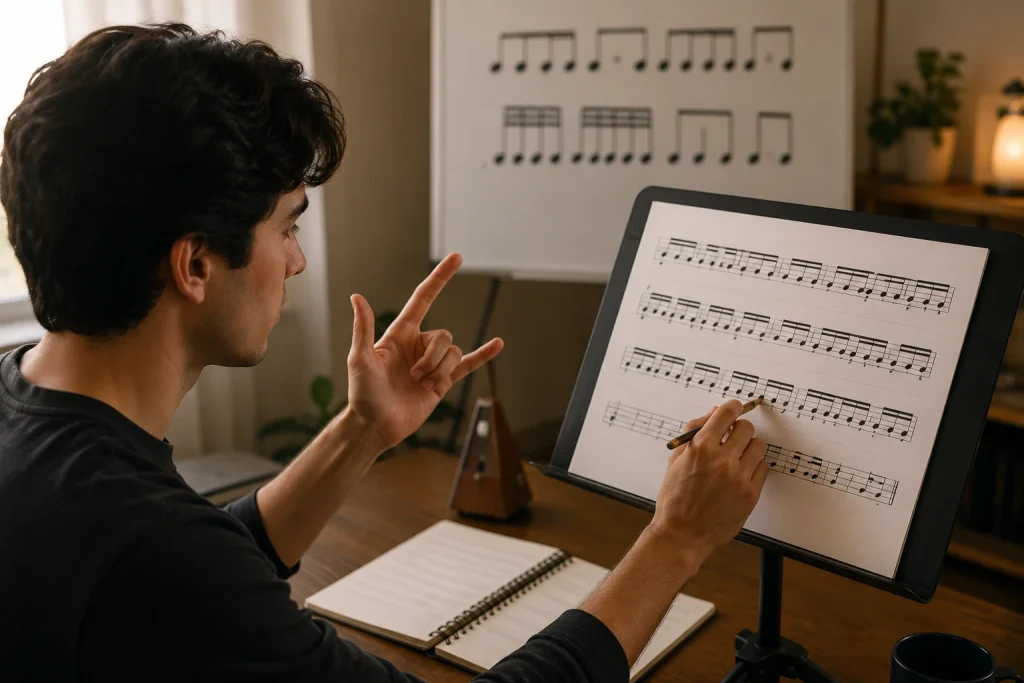
Rushing the main tempo
Beginners naturally speed up when they see heavy black ink on a page. The brain associates lots of notes with a faster overall tempo. This panic causes players to rush the main quarter note beat.
You must trust the metronome click entirely. The physical space between the clicks remains exactly the same. Only your internal hand movements should accelerate to fit the notes in.
Tensing physical muscles
Playing eight notes per beat causes severe physical tension. Musicians often lock their wrists or tighten their shoulders during fast passages. This physical stress makes accurate timing impossible.
You must stay completely relaxed to play fast subdivisions. Breathing evenly helps calm the nervous system during difficult sections. Loose muscles move much faster and cleaner than tight muscles.
Tempo context and practical speed
Handling extremely fast tempos
Speed dictates how you actually play these written notes. At very fast tempos, these notes blur together entirely. They act as decorative sounds rather than strong melodic beats.
Drummers use them to create rapid snare drum rolls. Piano players use them for quick ornamental trills. You do not count every single note consciously at these high speeds.
You aim for the general duration of the beat instead. The exact mathematical count becomes less important than the overall musical feel.
Playing at slow speeds
The situation changes entirely during slow musical pieces. Composers write these fast notes to create movement in slow songs. They appear frequently in tempos classified as adagio or largo.
At slow speeds, every single note acts as a distinct melody. You must play each pitch accurately and completely evenly. The math matters greatly in these quiet moments.
Quiet music requires precise control to maintain the emotional mood. An organist might use a slow tempo for a memorial service. This music sets a respectful tone, much like picking funeral notes for flowers. Fast notes must not disrupt this peaceful environment.
Frequently asked questions
How many thirty-second notes fit in one beat?
There are exactly eight of these notes in a single quarter note beat. A standard measure in four four time holds thirty-two individual notes total.
What do these notes look like on paper?
They have a solid black note head and a straight vertical stem. They feature three individual curling flags or three thick connecting horizontal beams.
Why are they called demisemiquavers?
This is the traditional British terminology for the exact same note value. American musicians use the fraction-based name instead. Both terms describe the same mathematical fraction of a beat.
Do I have to count them out loud?
You should count them out loud when learning a new piece slowly. Advanced players stop counting aloud at fast speeds and use mental grouping instead.
How do I practice them without rushing?
You must use a metronome set to a very slow tempo. Practice climbing the rhythmic ladder from quarter notes up to thirty-second notes slowly.
Final takeaways
Mastering fast rhythms takes daily practice and patience. You must understand the basic fraction system before attempting to play. Memorize the visual symbol of the three flags or beams first.
Use the basic “ta” syllable method to track your timing verbally. Start your practice sessions with a metronome set to a slow tempo. Climb the metronome ladder to feel the speed multiply naturally.
Remember that tempo dictates how these notes function in a song. They act as clear melodies in slow songs and quick trills in fast songs. Consistent practice will help you recognize and play them accurately over time.